Castle Berwartstein
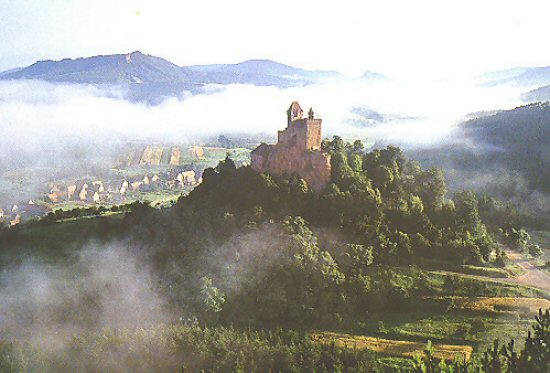
Castle Berwartstein stands high on a huge red rock in the South Pfalz of southwestern Germany. In earliest times, the only way up this rock was through a hole passing up from its base, which was entered by passing down a ladder or rope. This could be easily defended by a single person with hot pitch or tar. It is generally accepted that this uncommonly safe place had already been used as a refuge and protection for a long time before the castle was built. The earliest existing written mention of Berwartstein comes from the year 1150, but the village of Erlenbach (which is at the base of the castle mount) is mentioned from around 740.
Settlement of these lands took place in
the earlier Frankish era around the 6th Century. By the latest time of this
era the castle's rock would had surely have been discovered, (If not already in
use ages before), and we can reasonably assume that the castle was
constructed some time shortly thereafter. This must have been an extremely
laborious and lengthy job, because at that time all parts of the castle had
to be hand chiseled from the compact rock. During this initial stage, which
lasted several centuries, it existed purely as a cave castle. On approach, the entrance
was hardly recognizable, difficult to find, and impossible to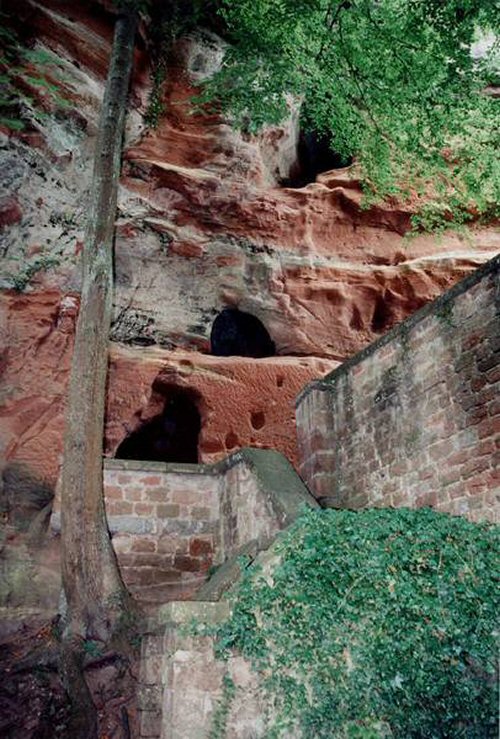 enter without the consent of the inhabitants. With the increasing settlement
of the local environment, "hiding places" such as this became useless; as you
could easily gain access by additional construction such as a siege tower.
Nevertheless, the caves remained the center of the castle. Even today, the
well and the many rooms which were chiseled out of the rock are impressive.
A substantial part of its defensive strength was an available source of
water, which in this case was in the form of a well dug through the solid rock,
which reached the water table and thus a safe water supply at a depth of 104
meters!
enter without the consent of the inhabitants. With the increasing settlement
of the local environment, "hiding places" such as this became useless; as you
could easily gain access by additional construction such as a siege tower.
Nevertheless, the caves remained the center of the castle. Even today, the
well and the many rooms which were chiseled out of the rock are impressive.
A substantial part of its defensive strength was an available source of
water, which in this case was in the form of a well dug through the solid rock,
which reached the water table and thus a safe water supply at a depth of 104
meters!
These days, we can hardly imagine how this was done by hand.
In the year 1152 Berwartstein stepped into
verifiable history as an empire castle. Emperor Friedrich Barbarossa gave it
to Bishop Guenther von Speyer. The bishop then gave the castle on lien to a
loyal knight, Rudolph, who thereafter took the name von Berwartstein. It was
around 1201 when the von Berwartsteins acquired the castle as their own property.
 With
it they had a nearly insurmountable base from which to draw their
livelihood, and often by violence. Their subjects performed duties and paid
their tithes of course, but moreover the Berwartsteins attacked and raided
into the neighboring lands. This behavior was not regarded as a dishonor at
all in this time and was usual in most areas among the many knights. The rise of
the "Robber Knights" (Raubritter) as they were called came in the time
period of the "interregnum", when Germany was loosely knit and the
strong hand of an Emperor was absent. In this particular period,
many of the national princes simply did not take any action against the
robber knights, partly because of worries of their own, or by design, and
partly because of their open friendships with the lawbreakers, much of it
earned on battlefields. This robber
knight class had made its honor and fame through their relationships,
bloodlines, conquests, and skill in battle. They lived following the principles of
the old German right of feud, or Fehdrecht. Those which served faithfully,
or had impressed and made friends of the higher kings and princes sometimes
obtained estates or fiefs on lien in return. As an added bonus,
With
it they had a nearly insurmountable base from which to draw their
livelihood, and often by violence. Their subjects performed duties and paid
their tithes of course, but moreover the Berwartsteins attacked and raided
into the neighboring lands. This behavior was not regarded as a dishonor at
all in this time and was usual in most areas among the many knights. The rise of
the "Robber Knights" (Raubritter) as they were called came in the time
period of the "interregnum", when Germany was loosely knit and the
strong hand of an Emperor was absent. In this particular period,
many of the national princes simply did not take any action against the
robber knights, partly because of worries of their own, or by design, and
partly because of their open friendships with the lawbreakers, much of it
earned on battlefields. This robber
knight class had made its honor and fame through their relationships,
bloodlines, conquests, and skill in battle. They lived following the principles of
the old German right of feud, or Fehdrecht. Those which served faithfully,
or had impressed and made friends of the higher kings and princes sometimes
obtained estates or fiefs on lien in return. As an added bonus,
 they could also not be taken to trial
over anything by any other than their fellow ruling class, legitimizing any
of their acts, good or bad.
they could also not be taken to trial
over anything by any other than their fellow ruling class, legitimizing any
of their acts, good or bad.
This favor in the eyes of the nobility and the power of being given
lordships over castles as absolute rulers of their lands gave these knights
the ability to extract goodly sums of wealth from many various endeavors.
Many of these were of the type some would think of today as quite violent
and oppressive, at times simply criminal; exorbitant tolls on roads and
trade going through their and nearby lands, ransoms on those captured, raids
and looting into neighboring properties (often resulting in feud, even to
the total capture of other rulers' lien possessions). These feuds gave cause
for interventions both contrived or otherwise by the controlling princes,
kings, emperors and clergy.
Many, myself included, see this time as a romantic period of bawdy
chivalry and valiance punctuated by fateful history. What legends are made
of. Some see it as a time of ruthless barbarians and oppression, what
legends are also made of
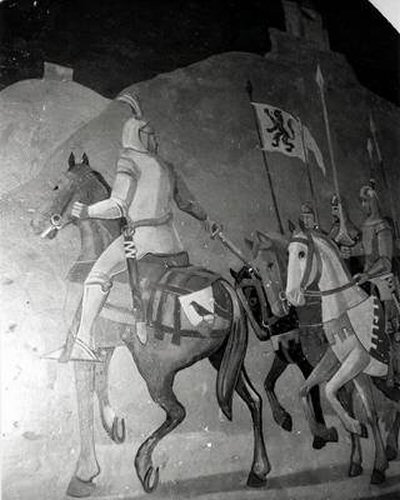
Those cities or lords damaged in these feud raids had to fend for themselves. In reprisal for the Berwartstein knights' conquests, the particularly damaged empire cities of Strasbourg and Hagenau joined together and prepared to conquest Castle Berwartstein and punish its ruler. To capture Berwartstein is no easy task, as before mentioned, it is virtually undefeatable by force of entry. The siege dragged on several weeks with no success until a betrayal from within the castle allowed them to conquer it and take prisoner the garrison of some 25 defenders. The Berwartsteins had to pay a very high ransom, and had otherwise lost too much to recover. They were forced by bankruptcy to sell the castle in 1343 to the brothers Ort and Ulrich von Weingarten, who sold it soon thereafter to the Weissemburg Abbey, which remained in possession of it for 132 years. The village of Erlenbach which lies below the castle but belonged to the neighboring von Drachenfels at the time was also destroyed in the siege.